No plan for planning?
Mark, a young pipe fitter foreman was driving over to his shop to meet with Steve, a seasoned Project Manager at Prism Plumbing and Heating’s home office. Mark had all the characteristics that his leaders looked for in an upcoming foreman: great work ethic, eagerness to learn, and a great communicator. Mark even had the respect of the older mechanics within the company.
The company was recently awarded a sizable multi-million-dollar mechanical contract with the chance to work for the first time with Grant Construction, a large local general contractor. Though he was still young and never ran a large project before, Mark was tapped to head this project as the lead foreman, that is how respected he was within his company.
Mark felt anxious that sunny morning as he drove to the jobsite to participate in his very first pull plan meeting set up by the general contractor. The meeting was a last-minute request by the project superintendent to try to work out a rough baseline project schedule with all the trades.
Mark usually felt comfortable going to project meetings, but he had no experience with pull planning, and Grant Construction didn’t provide an agenda with the meeting invitation. Mark was unsure what the expectations were, not being familiar with the process.
To make matters worse, Steve, his project manager called him the previous afternoon, “Hey Mark, you must go to a pull plan meeting tomorrow for the Hospital job. Can you stop by in the morning and grab the drawings?”
“Yeah, no problem” Mark responded.
“Just so you know, Steve, I haven’t been to a pull plan meeting before, what do I need to do for it?”
“Ah, just show up to answer whatever questions they have about the mechanical stuff. Grant Construction like to do that “post it note” planning nonsense. Lean construction is the newest management thing they are into, so just give them some face time and fill out whatever color post it notes they assign to us.” Steve said laughing out loud.
“Okay, I will do my best, boss.” Mark sincerely replied.
As Mark stepped into the project trailer for the meeting his nerves were not at all soothed when he was immediately greeted coldly by Greg, Grant constructions project superintendent, “What company do you work for?”
“Prism Heating and Plumbing” Mark sheepishly replied.
Greg was a gruff character with thirty years of construction experience. With his retirement coming up in less than six months and having been strong armed into doing the “lean construction” stuff that was now a companywide mandate, he was less than enthusiastic about hosting this meeting.
“Ok, well grab a sharpie and a couple green post-it note pads and find a seat” while turning to grab his coffee cup off the plan table, not at all interested in being cordial to his meeting attendees.
Mark grabbed the green pad as directed and sat down at the table. The long plastic gray table was filled with a dozen or so solemn faces; for the most part nervously staring down at their cell phones filling the time trying to look busy before the meeting started.
Frustrations set in
After a few quiet minutes, Greg turned to the group seated at the table, “Before we start, I hope everyone has spent time with your drawings and are ready to go through your work scope, durations and equipment lead times.”
Greg continued, “Because it will be a waste of everyone’s time if you haven’t.”
Mark immediately felt nauseous. He had not even opened the set of drawings he picked up that morning from Steve. He reluctantly slowly raised his hand.
“Yes… you have a question already?” Greg barked.
“To be honest, I literally just picked up the drawings before I came here for the meeting” Mark bravely admitted.
“WELL THEN…PICK UP YOUR DRAWINGS AND GET OUT OF MY TRAILER!” Greg responded in a fit of outraged frustration pointing to the door.
With his hands visibly shaking Mark clumsily rolled up his plans without so much as hesitation at the command.
All the while Greg glared across the conference room looking around table as he went on, “I am not putting up with this unprofessional behavior on my project. I hope the rest of you don’t have the audacity to have come to this pull plan schedule meeting and not have a clue of what your scope is!”
Mark’s face was bright red as he stood up and headed straight to the door avoiding any eye contact with the other nervous faces in the room. All their eyes fixed upon him, or at least that is how he felt.
Not a great start to building trust and respect for each other on the jobsite. Both Grant Construction and Prism Heating & Plumbing came to this meeting unprepared, one out of inexperience. The other out of indifference, with a lack of respect for people and lean process. But they both seemed to have felt like captives to lean construction methods forced onto them by others, instead of enthusiastic participants working and collaborating with one another to create a project they both could be proud of.
It all could have been avoided
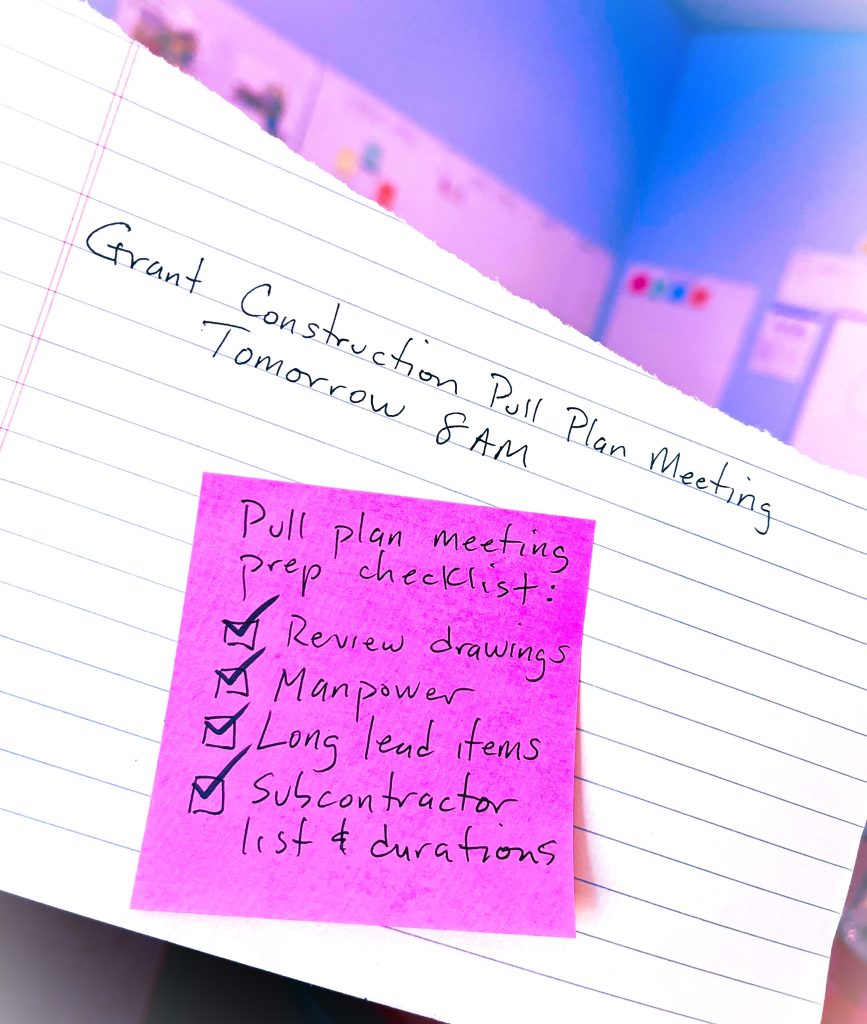
This doesn’t have to be the case, with a little bit of understanding on why lean practitioners do pull plan sessions, and the basic how to participate or lead a session is a good place to start. Here are steps you could take to avoid what everyone in that trailer experienced that day.
Tip #1 Provide a meeting agenda
Greg didn’t set up the project team for a successful pull plan meeting when he decided not to send a meeting agenda out to the subcontractors in preparation for the meeting. If you want to have a successful pull plan session you should be letting the project team know what the expectations are in advance. This will help the project team prepare for the meeting properly and be ready to be fully engaged when it is time to participate. It will also help with the anxiety that may come with attending the meeting, especially those who have little or no experience in the pull plan process.
Make sure to start the meeting with individual introductions, and an ice-breaker question. Creating a good team environment right from the start of the meeting will set that collaboration feeling to the meeting. This will again help minimize the amount of anxiety those attending may be experiencing and start the trust building you need to have a productive session.
Be sure to listen to the team members, understanding their needs will be useful to everyone. Try not to judge those who are reluctant to fully participate at first, but instead try to use this as a chance to coach. There will always be the impulse for team members to hold back information or sandbag their durations to protect themselves. This doesn’t mean do not challenge the information they are providing, but instead ask questions out of an inquisitive mindset. Backing team members into a corner with challenging questions may be counterproductive and create a defensive meeting environment.
Instead, ask questions like:
“Mark, I see you have 21-day duration for mechanical piping rough-in at the mezzanine area? I am curious what your thoughts are on how you came up with that? The last project I was on we did have a very similar situation as here, and it took 14 days to complete. But I understand this is a different situation and I was hoping to learn more about what your thoughts are. I don’t want you to cut your crew short on the time they need, but I would also not want to add time to the schedule that we may not need. Can you walk me through that so I can understand better about the work in that area.”
Remember, that when you are leading a pull plan session, it is all about getting the most accurate information from all the team members to create a quality and realistically obtainable schedule.
Leaders need to gather information from those closest to performing the work. Creating the right environment and meeting setting to get the trust of the participants is important.
It starts with that meeting agenda, that is the place where a good leader you can set the expectations.
Tip #2 Review the contract drawings
It really is a waste of everyone’s time to attend a pull plan meeting without first getting familiar with the project drawings and specifications.
Steve sent Mark to that project pull plan meeting unprepared. Project managers should understand that skipping the proper turnover of a project to their field staff is not an effective way to kick off a job. It may seem like a waste of manhours having your foreman review drawings in advance of actual mobilization, but the real waste is having manpower show up to work and not have a plan to start the work.
When the foreman has had the chance to thoroughly review the drawings and gain an understanding of the project scope prior to the starting the work is invaluable. The more intricate the project the more emphasis on early reviewing the drawings should be made. Time should be budgeted for that phase for the project. This way your team is prepared to attend meetings and properly plan out the work sequence while starting to identify potential issues that there may be prior to having wasted manpower standing idle.
Tip #3 Understand your manpower needs
To plan the project out on paper properly, everyone participating in the pull plan session need to have a good handle on what the manpower load is going to look like. After gaining some insights about the project details and timelines it is a good practice to project out the manpower through the duration of the project.
This is where communication between the estimating and the project team is crucial since the estimators have already a good sense of the manpower flow based on the take-off. So many times, a project just gets passed on from preconstruction to the construction team without any meeting at all. This is a lost opportunity. There is already some knowledge of the project that could be shared but this meeting is seen as a waste of time.
Try to use all the resources you can to understand project manpower before attending the pull plan meeting, and meeting organizers be sure to afford the contractors that time after project award to do just that.
Tip #4 Bring a list of the materials with long lead times
It is no secret that troubles with equipment lead times over recent years have been a construction manager and general contractors’ nightmare. Once again, the estimating team can be very insightful and a great resource regarding material and equipment availability. Try to have at least a basic understanding of the material and equipment lead times for the project meeting, this will be very important information to use while pull planning.
Tip #5 Engage with your subcontractors, engineers, and services providers
Be aware that some of the information that will be needed at the pull planning session will be related to your scope be provided by your sub-tier contractor and service providers.
When practicable, try to schedule having them attend the meeting as well, but at the very minimum get the pertinent information they need to provide. Like their lead times, permits and manpower schedules for the work they are performing for you. Without this information there could be big gaps in the pull plan schedule that could be avoided with some solid preemptive research and phone conversations ahead of time.
Pull plan meeting organizers should request this when you send out your meeting agenda and encourage second-tier subcontractors participating in pull plan sessions whenever they are available to attend.
Enjoy the confidence that comes with understanding!
Ease always comes with understanding what to expect when we encounter new things, and now you are equipped with some basic knowledge that hopefully gives you some courage to tackle your first pull plan session. Whether you are leading the meeting or a participant you can bring valuable insights at the meeting when you are properly prepared.
Pull planning is designed to have the field staff, those who are close to performing the work, inputting the information needed to build an accurate schedule. When both organizers and participants are well prepared and understand the process, it is by far one of the most effective ways to create a collaborative work schedule. But like most things, if the pull planning session is not planned or is poorly run and the participation is not a true collaboration of tradesperson sharing accurate information it is just another lean tool that is underused.
Be the best collaborator
So good luck to all you lean construction practitioners. Remember collaboration is the key to success, so whether you are running the pull plan session or a participant there is plenty of planning ahead of time you can do to make your meeting a meaningful experience for all.